During a trip to Spain, Niki de Saint Phalle discovered the work of Antoni Gaudí and was greatly influenced by it; in particular, Park Güell in Barcelona was of great importance in her decision to build her sculpture garden, also inspiring her to make different materials and found objects the main elements of her art.
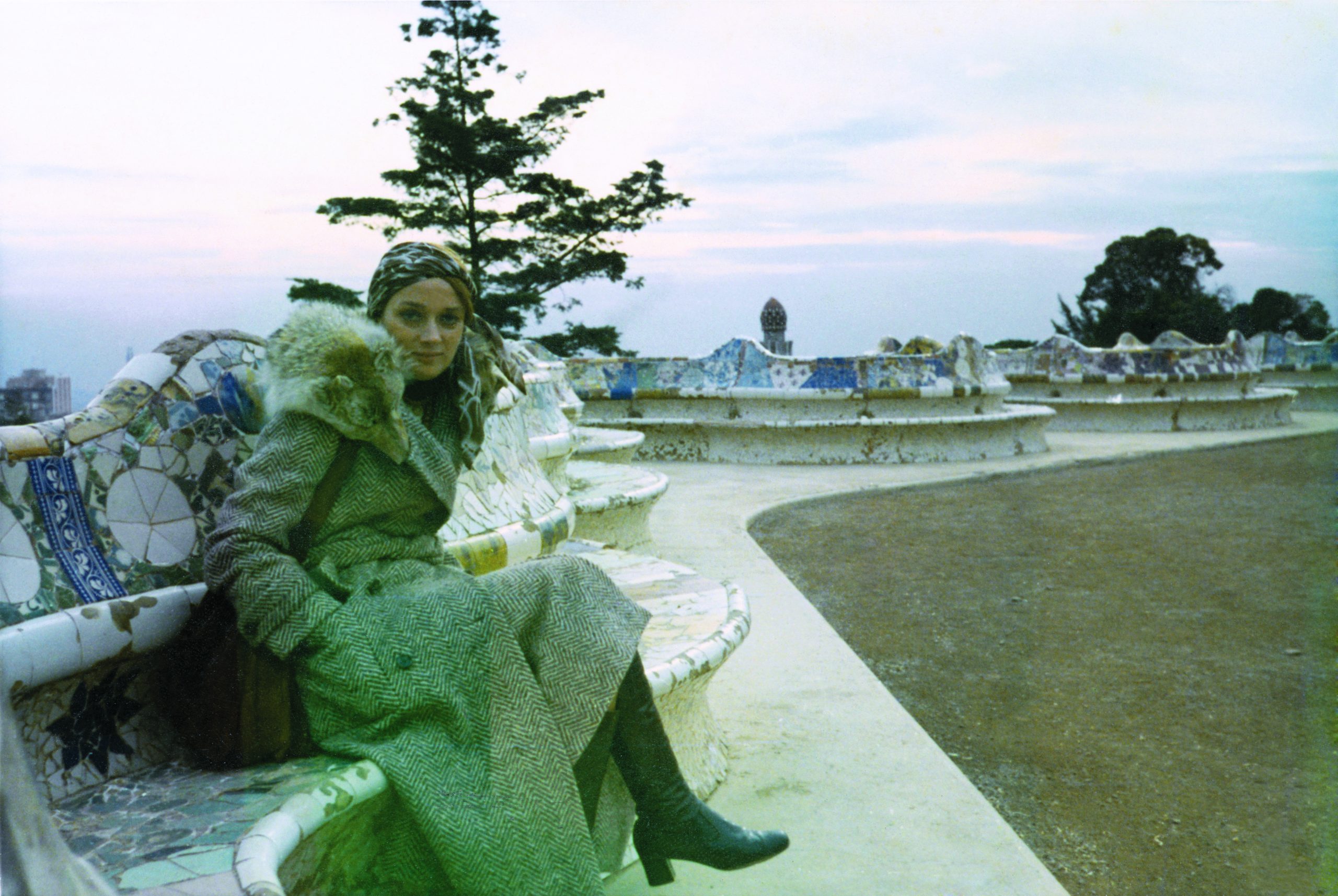
Niki de Saint Phalle at Parc Guëll, Barcelona, 1955. Photo: © unknown.
Niki de Saint Phalle visits Ferdinand Cheval’s Ideal Palace with Jean Tinguely; he, a postman, had built a palace in Hauterives (Drôme, central France) based on images from his naive imagination. Later, Tinguely would bring the New Realists to the headquarters to learn more about Cheval’s construction.
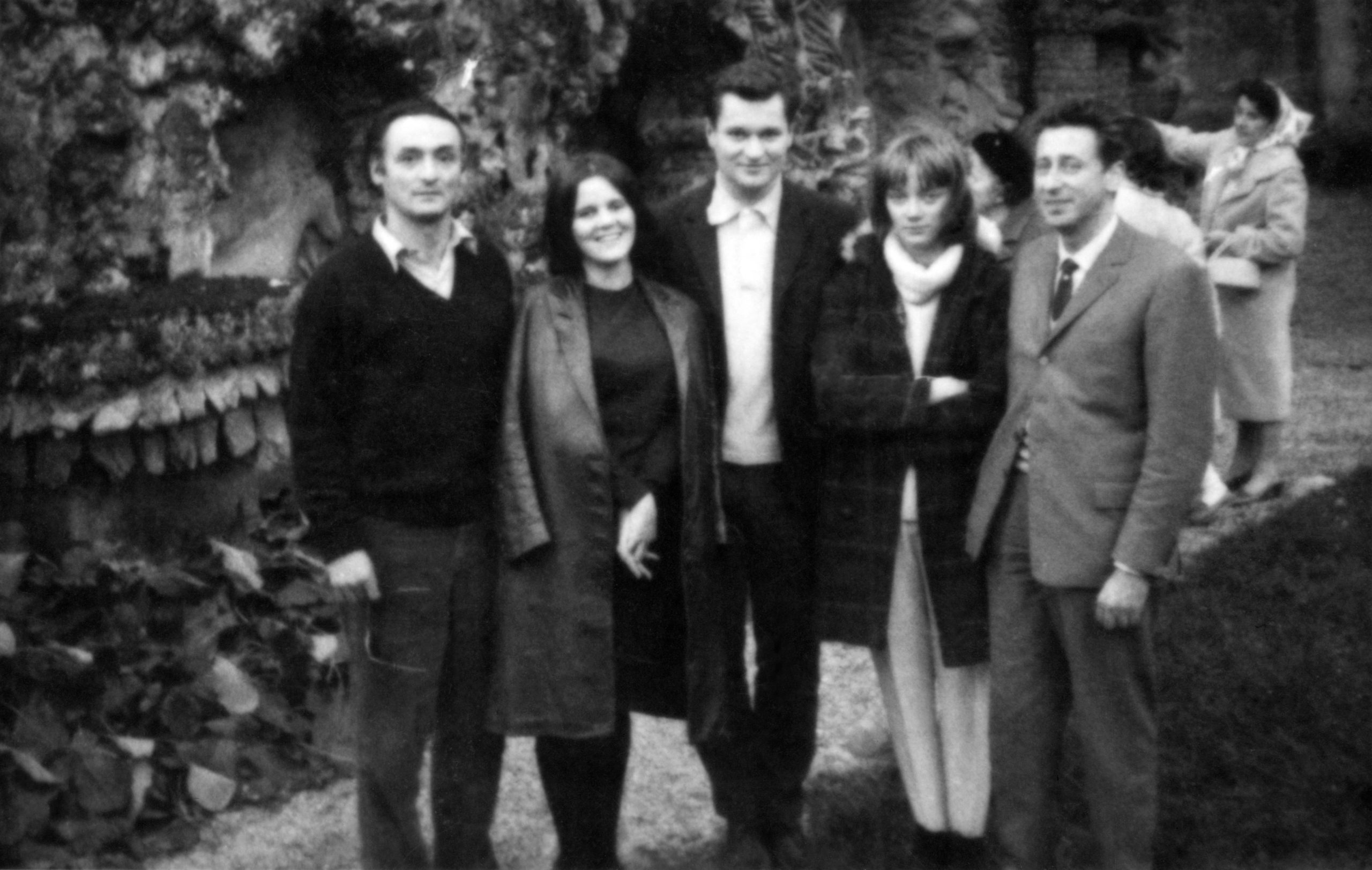
Palais Idéal du Facteur Cheval, December 31, 1961 (from left to right: Larry Rivers, Clarice Rivers, John Ashbery, Niki de Saint Phalle, Jean Larcade)
Photo: © unknown
Niki de Saint Phalle and Jean Tinguely take a trip to California; they visit Watts Towers by Simon Rodia in South Los Angeles.
Saint Phalle collaborates with others on the Hon project for the Moderna Museet in Stockholm. The giant sculpture causes a worldwide sensation, intensifying Niki de Saint Phalle’s desire to create her own sculpture garden. In Stockholm, Saint Phalle and Jean Tinguely meet the young Swiss artist Rico Weber, who will be their assistant and colleague for many years, playing an important role in the creation of the Tarot Garden.
Niki de Saint Phalle began collaborating with polyester specialist Haligon, who created large-format sculptures and multiples for her.
In June, Saint Phalle created the model for the Fontaine-de-Nana, which was enlarged in 1990 and in March 1993 found its place in the Tarot Garden. After being hospitalized for a lung abscess caused by many years of working with polyester, Niki de Saint Phalle remained in St. Moritz for a period of convalescence.
There, she met Marella Caracciolo Agnelli again, whom she had met in New York around 1950. Saint Phalle expressed to her friend her dream of creating a sculpture garden based on the symbolism of tarot cards. Later, Marella Caracciolo Agnelli’s brothers, Carlo and Nicola Caracciolo, provided her with a plot of land on their estate in Garvicchio, Tuscany, where she was able to realize her dream.
The Tarot Garden project would occupy Saint Phalle’s thoughts and creative energy for twenty years.
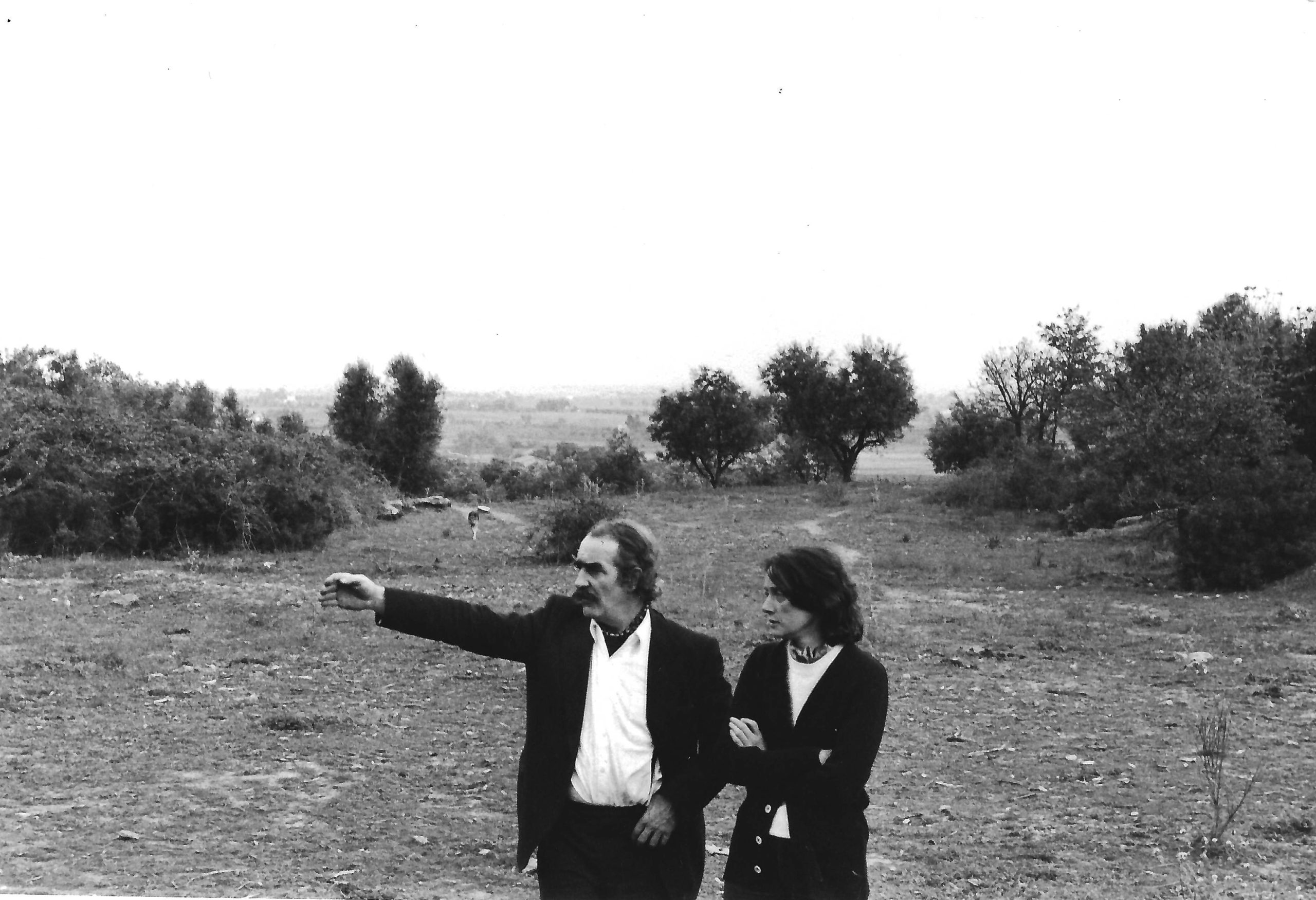
Jean Tinguely and Niki de Saint Phalle, futur land of the Tarot Garden, 1978. Photo: Laurent Condominas
Niki de Saint Phalle returns to the Swiss mountains for a rather long period where she works on the design of her sculpture garden; she conceives as figures that should populate her as figurative expressions of symbols, hints and energies of the tarot.
In 1977 Ricardo Menon became her assistant for the next ten years.
Saint Phalle starts working on her Tarot Garden on the land owned by Carlo and Nicola Caracciolo, in Garavicchio in southern Tuscany. She developed the first models which were based on the Major Arcana of the Tarot and anticipated the mega-sculptures of her garden.
In Paris she met Pierre Marie Lejeune in whose studio-shop his prints and sculptures were produced; she assigns him the task of painting the sculptures for the Stravinsky fountain in Paris together with her.
Niki de Saint Phalle spends most of her time in Tuscany. The land will be cleared and cleared, and foundations will be laid. For the next ten years Saint Phalle will be mainly involved in the construction of her garden, obtaining the help of numerous of her friends and followers.
Ugo Celletti, a postman, began working for the Tarot Garden in 1979; and, as Niki de Saint Phalle writes, “he first laid out stone paths, then applied wire nets to the iron buildings that had been sprayed with cement. Some time later Ugo asked me to test his ability to cover the sculptures with glass tiles for mirrors, proving himself to be a true poet in this type of mosaic”. Over time many local inhabitants worked for the Garden; in addition to those named here who will make notable contributions, there will be other helpers of both sexes.
The Gimpel & fils; Weitzenhoffer Gallery in New York organizes an exhibition with models and photographs of Niki de Saint Phalle’s architectural projects; the traveling exhibition stops in numerous American cities.
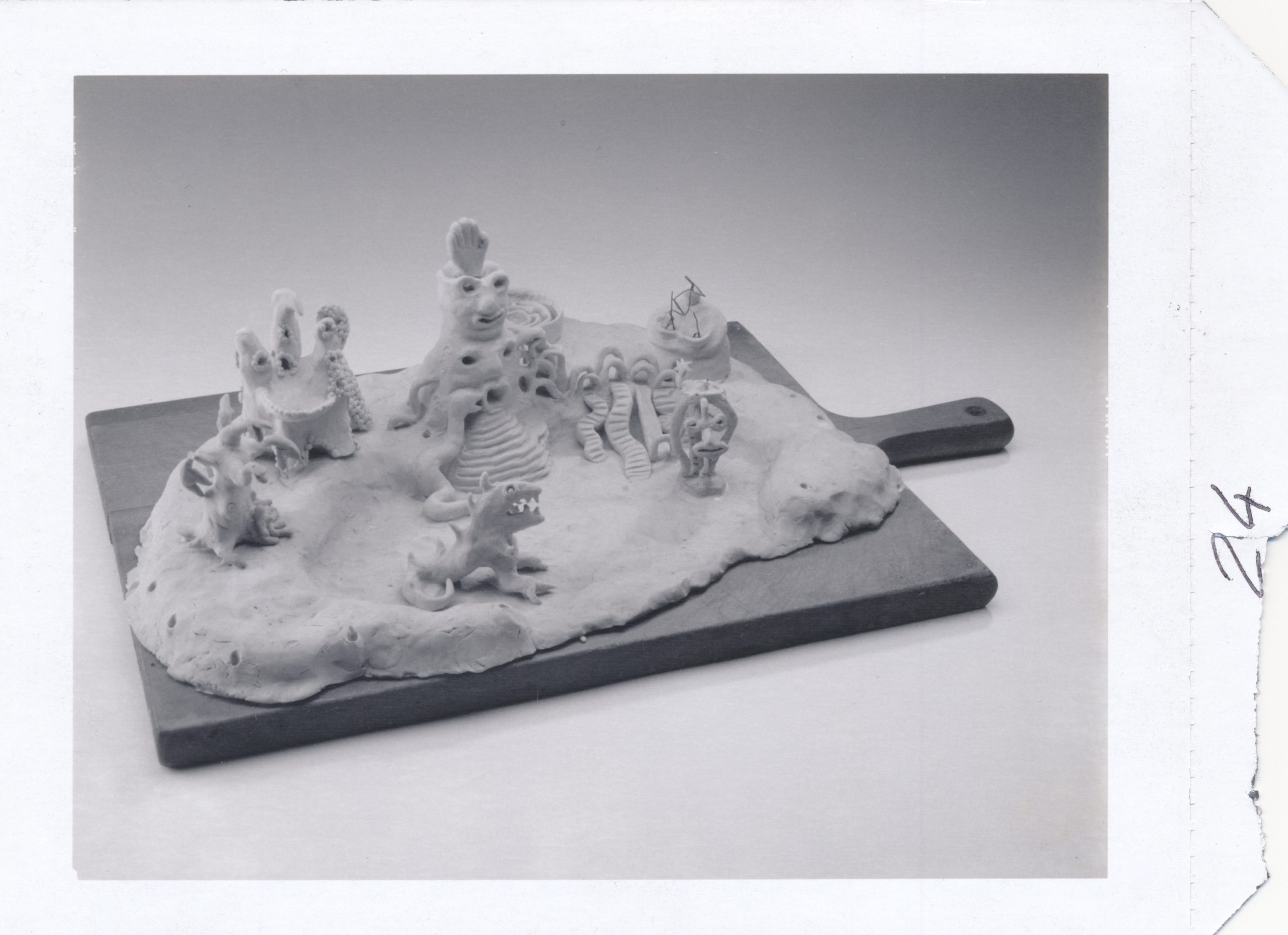
First maquette of the Tarot Garden, circa 1978. Donation Sprengel Museum. Photo: unknown
In April Niki de Saint Phalle begins to build her first architectural sculptures for the Tarot Garden, The High Priestess and The Magician : first The High Priestess : the first to represent female creativity and strength. Between 1980 and 1982 Jean Tinguely and his Swiss team – Rico Weber and Seppi Imhof – welded the iron constructions for this first group of works of which The Empress (the Sphinx).
Pierre Marie Lejeune visits the Tarot Garden for the first time. Niki de Saint Phalle comes up with the idea of covering her works with ceramic and glass mosaic tiles for mirrors. Pierre Marie Lejeune has collaborated with her for years. During his travels through Poland, Czechoslovakia, France, Germany, Belgium, Italy and the United States he is always looking for new materials and techniques.
He has certain elements produced according to Saint Phalle’s instructions; he develops a technique for covering sculptures with mosaics; he appoints his wife Isabelle Dunoyer de Segonzac to manage the mosaic workshop. Saint Phalle gives him carte blanche to design benches, furniture and other elements for the Garden.
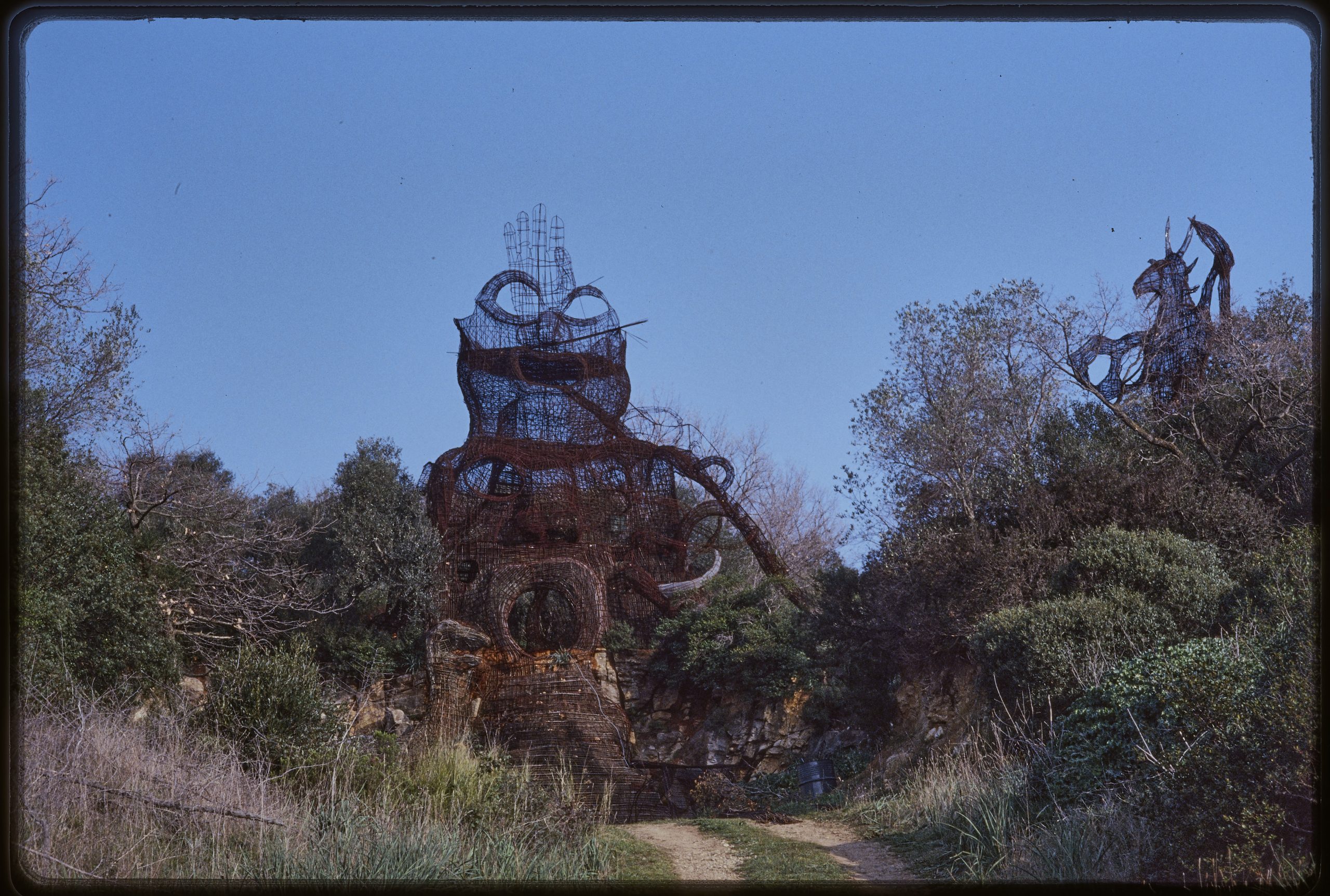
The High Priestess and The Magician, iron stage. Circa 1980-1981. Photo: Rico Weber © MAH Fribourg
Niki de Saint Phalle rents a small house near the Tarot Garden; she hires staff from the surrounding farms who will help her carry out this enormous undertaking of hers. The success of the project is decisively due to her many years of work. The Tarot Garden continues to grow.
Dutch artist Dok van Winsen meets Niki de Saint Phalle in Amsterdam and later collaborates with Jean Tinguely (and Saint Phalle) on the sculpture Cyclop. At the end of 1981 he arrived in Garavicchio for the first time.
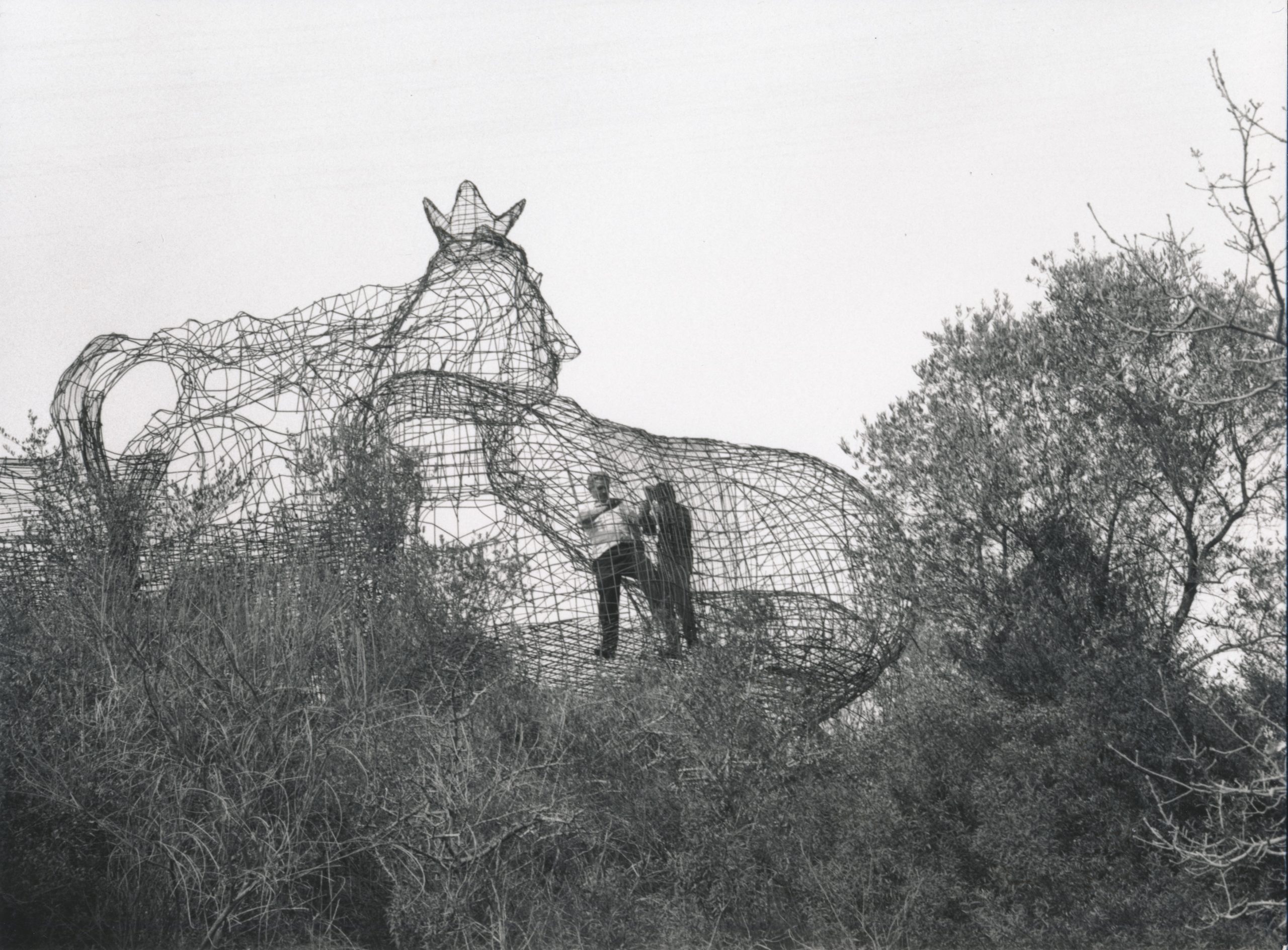
Welding the metal structure of The Empress. Photo: Rico Weber © MAHF Fribourg
Dok van Winsen joins the team and takes on Tinguely’s work: welding the iron constructions and sculptures. “Thanks to the ‘medieval’ education of Jean Tinguely and Dok van Winsen, the enlargement of my models works perfectly,” writes Niki de Saint Phalle. “All the armatures of the monumental sculptures are formed from iron bars and welded thanks to the muscular strength of the team.”
Tonino Urtis also joins the Team, to lend a hand to Dok van Winsen in the welding work of the first works of Tinguely and his Swiss team: The High Priestess, The Magician, The Emperor, and equally The Sun and The Tree of Life. All these sculptures arise at the same time, as Niki de Saint Phalle loves to work on multiple projects simultaneously. At the end of the year the works reached a level that allowed the cement applications to be carried out.
On behalf of the Jaqueline Cochran Company Saint Phalle creates a perfume that bears her name; sales are used in part to finance the Tarot Garden. To contain the perfume she creates a bottle in gold and blue and above it, like a knob, two tangled colored glass snakes.
Niki de Saint Phalle fell ill with rheumatic arthritis and would suffer from it until the end of her life.
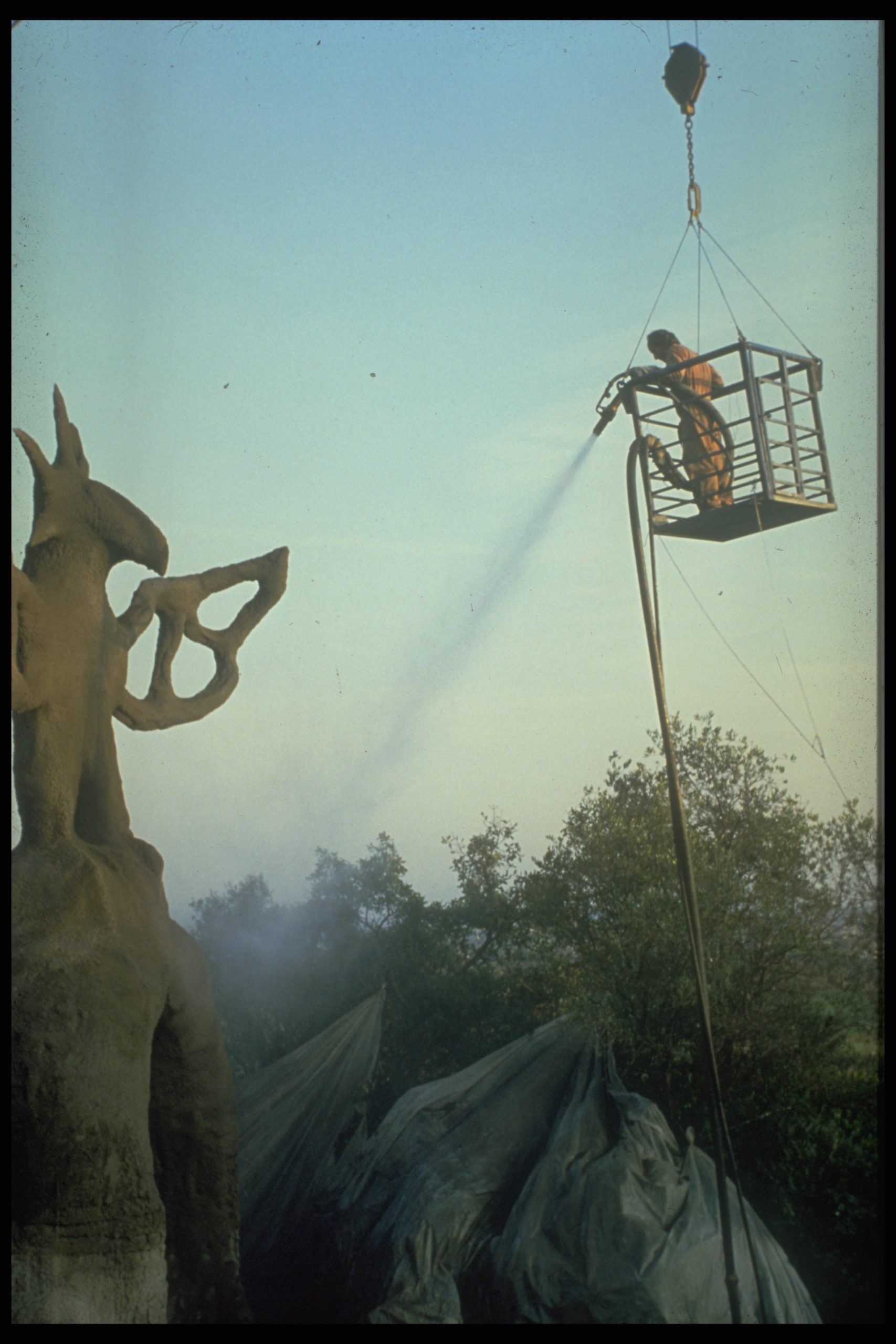
The Sun being sprayed by concrete. Photo: Giulio Pietromarchi
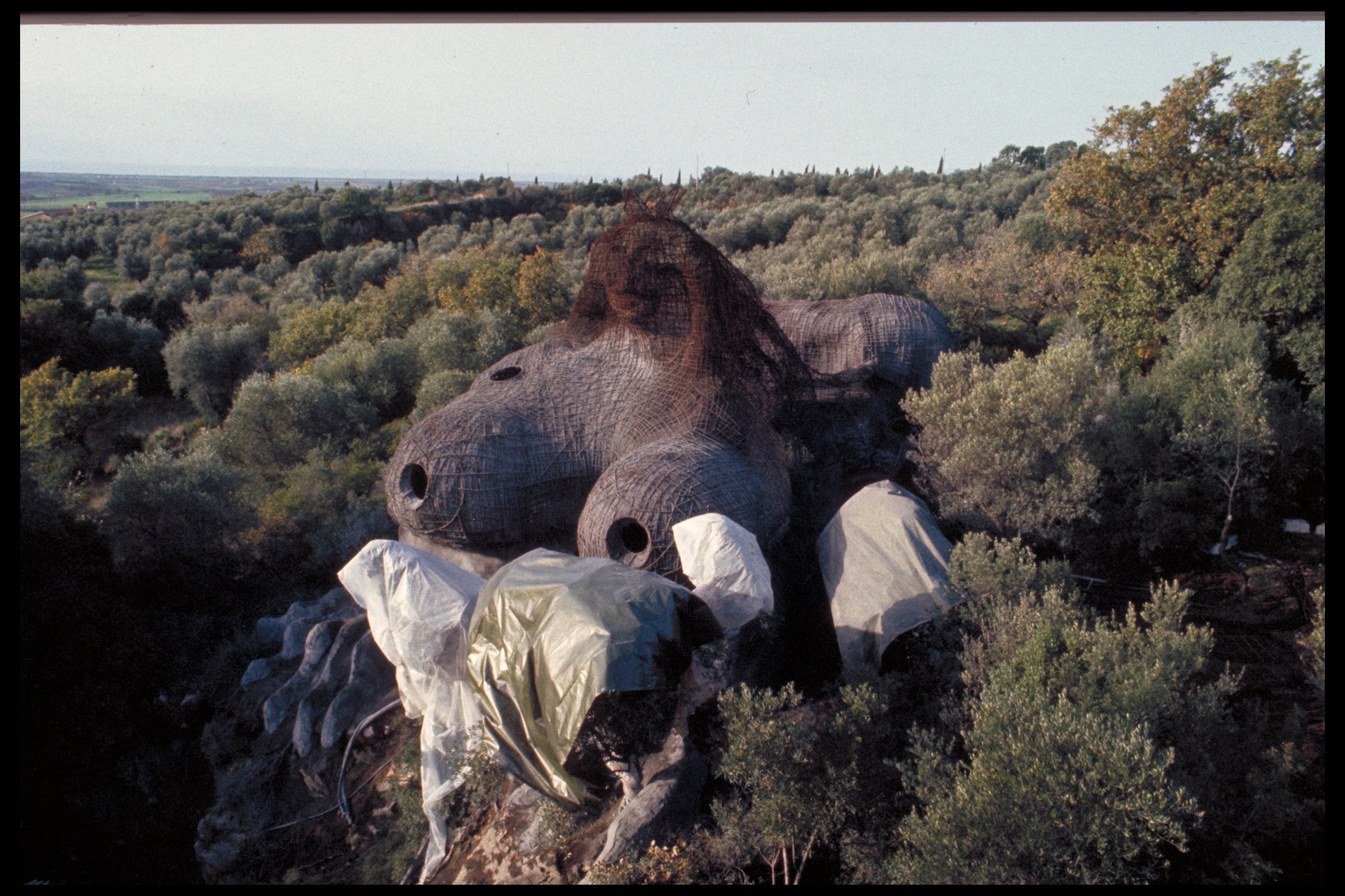
Niki de Saint Phalle moves into the monumental sculpture of The Empress which has the shape of a sphinx and will serve as an atelier and home for the next seven years, a period in which she works intensely on finishing the Garden.
She decides to use ceramic tiles alongside glass tiles for mirrors and glass to cover the sculptures. Her friend and assistant Ricardo Menon introduces her to Venera Finocchiaro, a ceramist teacher from Rome. “Venera was to become the ceramist of the Garden, she was completely immersing herself in her mono”, writes Saint Phalle. “She lived in the Garden and satisfied my desire to create brand new objects that had never existed before in ceramic art. Her beautiful works speak for themselves”.
Dok van Winsen helped by Tonino Urtis welds the second group of architectural sculptures: The Castle (The Emperor ), The Falling Tower, The Hierophant, Justice (with the exception of the arms of the scales that Urtis later produces in iron) and the chapel inside which The Hanged Man. After Tinguely suffers a heart attack, Saint Phalle solemnly promises to have a small chapel built in his honor if he recovers; so that The Hanged Man will be placed inTree of Life. Dok van Winsen begins work on The Hierophant (said by Niki de Saint Phalle to be “Jean’s favorite sculpture in the whole Garden”) which Tinguely will then complete.
Once the welding work has been completed, the sculptures will be covered with a second layer of iron on which two layers of wire mesh will be applied. As soon as the iron construction of the architectural sculptures was completed, De Villa, a specialized company from Ventimiglia, was commissioned to carry out the reinforced concrete works. De Villa applies a first layer of coating. Afterwards the interior of The Empress it will have a covering of insulating material and a metal mesh. Above a layer of tar to protect The Empress from the rain De Villa applies a final layer of white cement.
In the Garden the Strength (The Dragon ) with iron and cement and will then be covered with a mosaic.
Dok van Winsen begins welding work and returns to this sculpture several times, depending on Saint Phalle’s changing ideas about mosaic cladding. In 1989 The Strength sculpture will be completed.
Niki de Saint Phalle creates a model for The Moon (n. XVIII).
Between 1983 and 1984 Tonino Urtis created the first mosaic for the hand of The Magician.
Gérard Haligon and Pierre Marie Lejeune painted The Sun in the summer of 1983; this is Pierre Marie Lejeune’s first work in the Garden.
Between 1983 and 1995 he visited The Tarot Garden four or five times a year and stayed there for a week each time; between 1995 and 2002 his visits became less frequent.
Marco Iacotonio begins his activity in the Garden by giving the concrete the finishing touches. Between 1984 and 1987 Niki de Saint Phalle spent most of her time in the Tarot Garden; a large number of her major works are already in an advanced state of completion.
Pierre Marie Lejeune and Gérard Haligon create the model of the snake at the foot of The High Priestess and they produced the first ceramics and applied them with clay directly onto the concrete; the ceramics come from the production of Venera Finocchiaro.
In September Saint Phalle creates the models for Temperance (n. XIV) and for Death (n. XIII) so shortly after for The Choice (The Lovers) (n. VI). All three were then cast in polyester by Robert Haligon and his sons Gérard and Olivier.
For architectural sculptures not yet completed The Emperor, The Falling Tower, The Hierophant and Justice the concrete work begins. Saint Phalle’s team is now familiar with the working techniques, working from morning to night.
She bought a small electric cooking oven. Ceramic tiles produced on site will be applied around The High Priestess‘s mouth. The Magician eyes and face are made of pieces of mirror glass. For the firing, Toni van Winsen, Dok van Winsen’s wife, is responsible first, and then Venera Finocchiaro who together with Saint Phalle creates all the ceramics still present in the Garden. Two more cooking ovens are purchased; therefore it can rightly be said that all the ceramics were produced on site.
The work for the mosaic with glass tiles for mirrors for the exterior of The Falling Tower began between 1984-1985.
At the same time the large snake of The High Priestess and the face of The Magician.
Works based on Niki de Saint Phalle’s tarot cards are exhibited at the Gimpel Fils galleries in London and Gimpel & Weitzenhoffer in New York.
Jean Tinguely builds the machinery for The Falling Tower : the welded iron sculpture (300 x 400 cm) named Eos is equipped with an electric motor, symbolizing the wrath of God.
Other machines created by Tinguely for the Tarot Garden are The Fountain of Fortune (a variant of The Wheel of Fortune), a welded iron sculpture in 1988 with an electric motor in the water basin in front of The High Priestess, and The Injustice ; a welded sculpture composed of iron, found objects, lamadari and electric motors that will be placed inside Justice and protected by a gigantic padlock (n. VII).
The access road bears the sign “Jean Tinguely has unjustly imprisoned injustice within justice and has firmly closed the door.”
After creating the models in 1984, Temperance in February and The Choice ( The Lovers) in March were cast in polyester, a job carried out by Robert Haligon & Fils. In April the model for The Devil is produced.
1985 and 1986 work began on mirror glass and ceramic mosaics for The Empress (blue mirror glass mosaic hair), The High Priestess, the Fountain (exterior staircase), The Magician (face and steps), and The Hierophant (First Mosaics).
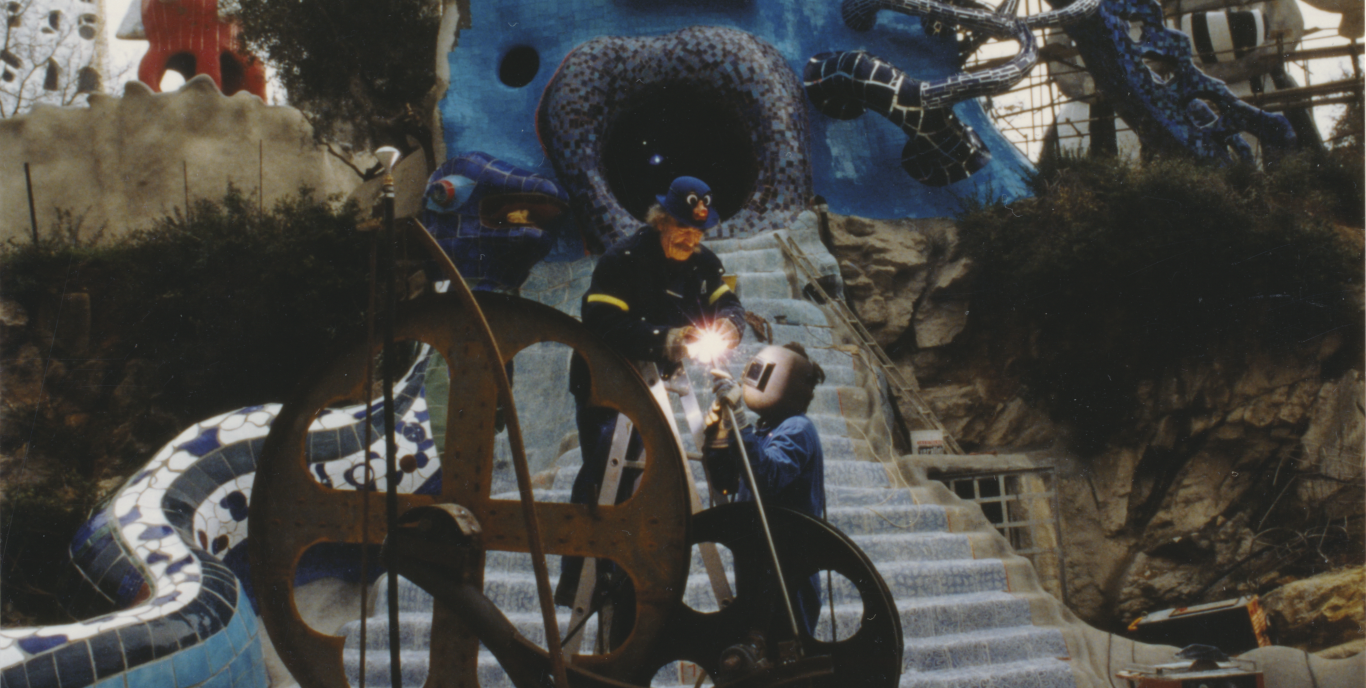
Jean Tinguely and his assistant Seppi Imhof welding The Wheel of Fortune. Photo: Laurent Condominas
Niki de saint Phalle spends almost the entire year in the Tarot Garden; further sculptures are placed there. Ricardo Menon introduces Marcelo Zitelli to Niki de Saint Phalle; he becomes her assistant and important collaborator. The glass mosaic mosaic intended for the exterior of the Tower will be completed between 1986-1987.
Claudio Celletti begins his work at the Tarot Garden.
Between 1987 and 1993, years in which Niki de Saint Phalle again spent more time in Paris, she created many smaller works for her Garden, including Death, The Hermit ,The Fool, The Devil, The Chariot, The Hanged Man, The Oracle em>, The Sage,The World, The Star, The Conversation, The Seat of Serpents . In March Saint Phalle developed a larger version (300 cm) of The Moon (no. XVIII) based on the 1983 model. Later still considered too small, between 1992-1993 it will be replaced by an even larger format (500 cm).
The Hierophant and Justice were completed between 1987-1988.
Niki de Saint Phalle asks Pierre Marie Lejeune to build benches around the fountain at the feet of The Empress (Sphinx). He proposes to create a small amphitheater with seats in the rock itself; and with the help of the hardworking team members this project will be implemented.
The Bonnier Gallery in Geneva exhibits “Latest works” by Niki de Saint Phalle, including limited editions of works based on the sculptures of the Tarot Garden: colored plastics and bas-reliefs in polyester, ceramic and glass, nemerated serigraphs as well as figurative and colored vases in polyester. The proceeds are used to finance the construction of the Tarot Garden.
Based on the model created in September 1984, in January Niki de Saint Phalle produced the sculpture of Death (n. XIII) together with her assistant Marcelo Zitelli. The Hermit (n. IX) will be created in clay in June. Both figures will then be cast by Haligon in polyester.
The Magician (n. I) and The High Priestess (n. II) were completed between 1988-1989. The work is now concentrated on The Empress (n. III) and, later on The Emperor (n. IV).
Living in the “Womb of his Mother”, meaning inside The Empress (Sphinx), felt to Saint Phalle like an influence that was too strong, so she built a studio in a secluded area of the Garden, in the style of a New York loft. In 1988 she spent part of her time there, before eventually moving in permanently.
Alessia Celletti begins working in the Tarot Garden.
Ricardo Menon died of AIDS; Saint Phalle was deeply affected by his passing. In his memory, she created the sculpture The Cat, so that a lasting reminder of him would remain within the Garden. During those years, Niki de Saint Phalle lost many friends, all taken by AIDS.
When she dedicates herself to her works, the experiences in the Tarot Garden are decisive for Niki de Saint Phalle and her way of dealing with materials, in particular with multicolored mosaics of glass mosaic tiles for mirrors and ceramics. In January 1989 she designed The World (n. XXI) which Haligon & Fils then made in polyester; a mosaic version will be placed in the Tarot Garden. Of The Devil model, made in April 1985 (n. XV), Saint Phalle developed a larger version in February. In August and November in Paris she created, together with her assistant Marcelo Zitelli, the models of The Fool (n. 0) and The Hanged Man (n. XII) in clay.
At Niki de Saint Phalle’s suggestion Pierre Marie Lejeune builds a concrete path which he decorates with hieroglyphs and other signs and symbols.
Strength (The Dragon) is finished.
In September, according to the model of June 1974, an enlarged version of Fontaines aux Nanas was born. The Hanged Man (n. XII) will be installed in November inside The Tree of Life ; in the same month The Devil (n. XV) will be positioned.
Between the late 1980s and the early 1990s, Niki de Saint Phalle spent increasingly less time in the Garden. The site, however, continued to develop, and at the same time the need for maintenance of the grounds and of the individual sculptures grew. Between 1992 and 1993, restoration work on the sculptures began, introducing new gluing techniques (using silicone for glass pieces and silicone for mirrors). Meanwhile, Saint Phalle worked to establish a legal framework for the Garden project.
In August Jean Tinguely dies in Bern.
Niki de Saint Phalle’s health conditions worsened, but she nevertheless worked to found a Tinguely Museum based in Basel; there the friendship with Mario Botta was born.
In November The Fool (n. 0) will be placed in the Garden. As if in a wandering he had already changed places several times and will do so in the future too…
A new and larger (500 cm) version of The Moon (no. XVIII) will be modeled.
In March Fontaines aux Nanas (i.e. Fontana-di-Nana) will be placed in the Tarot Garden, in June The Moon (n. XVIII).
For health reasons, Niki de Saint Phalle moved to La Jolla, California, where she would live for the next eight years. She organized her studio so that she could work with stone, glass, and mirror glass—materials that, instead of paint, became increasingly important in the development of her sculptures. Pierre Marie Lejeune traveled to California several times in search of suitable materials and to set up a mosaic workshop there.
Giampiero Ottavi begins his work as a gardener in the Tarot Garden. Pierre Marie Lejeune designs and creates iron and glass furniture. Between 1995 and 1996, almost all the mosaics for the sculptures were completed.
The “Anti‑Boutique”, designed by Pierre Marie Lejeune, as well as the furnishings, will be installed by him with the support of the team. On August 4, 1997, “Il Giardino dei Tarocchi” Foundation was established in Rome.
In 1997 Stefano Mancini became the administrator of the Tarot Garden, succeeding Gigi Pegoraro, who had previously overseen administrative matters.
Mario Botta designed the entrance pavilion to the Garden. “I asked my friend, the architect Mario Botta, to create the entrance to the Tarot Garden in contrast with the interior of the Garden,” writes Saint Phalle. “Mario built a thick enclosing wall resembling a fortress, which had a ‘masculine’ appearance, using the beautiful local stone, and in this way the exterior and interior were clearly distinguished. For me, Mario’s great wall is a form of protection, just like the dragon in fairy tales who guards the treasure.”
The Tarot Garden, which had already attracted visitors in the past, was officially inaugurated for the general public on May 15, 1998.
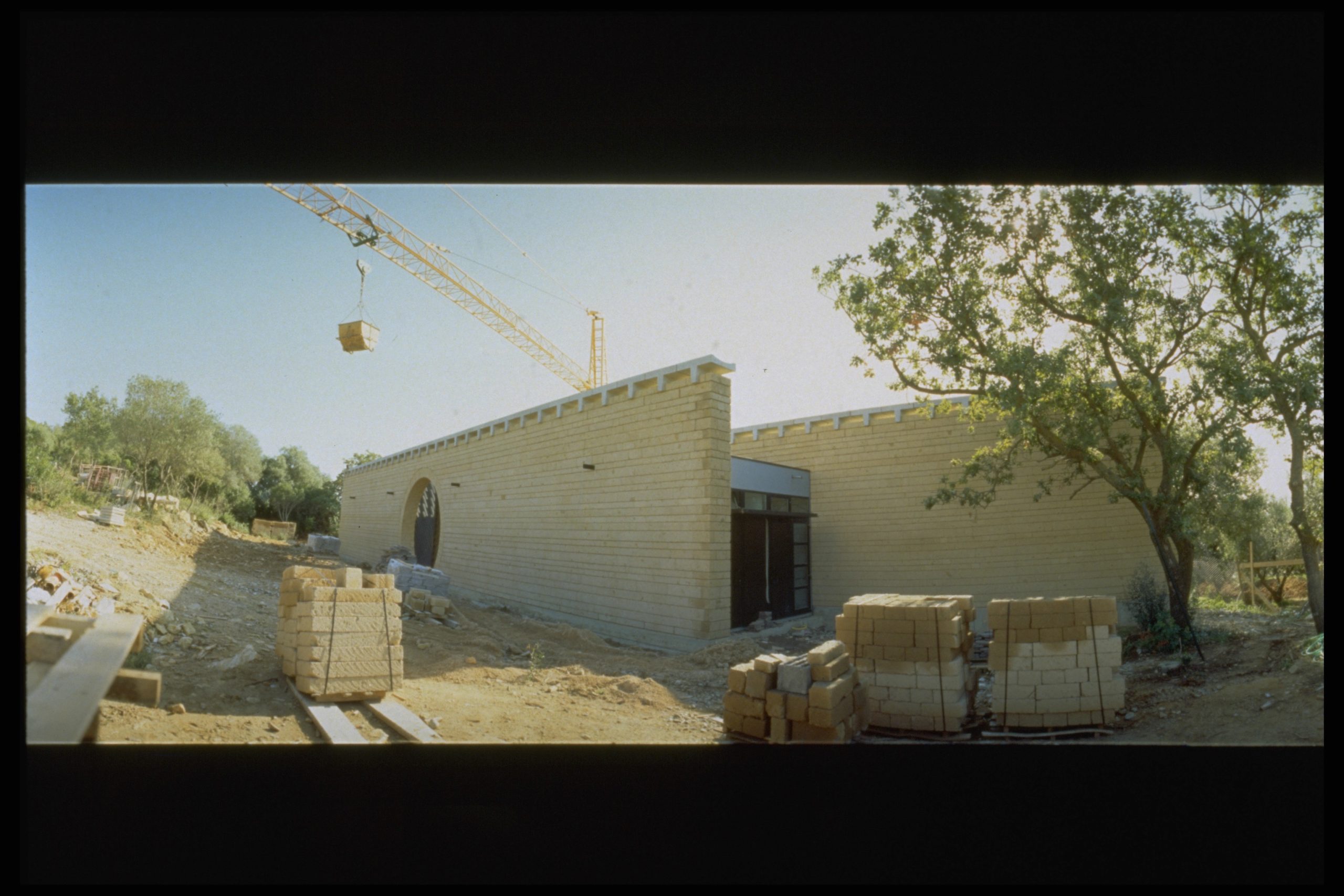
Construction of the entrance to the Tarot Garden, “the wall” by Mario Botta. Photo: Giulio Pietromarchi
Around 2000 Tonino Urtis undertook two trips to the United States to teach ceramic techniques to Saint Phalle’s new team in Southern California, necessary for her latest project Queen Califia Magical Circle in Escondido, California.
Fabio Mancini begins his work in the Tarot Garden; Massimo Menchetti joined him in 2004.
Although Niki de Saint Phalle moved to the United States, she did not abandon her Tarot Garden. She was designing a labyrinth, which would require clearing a plot of land to install metal poles.
On May 21, 2002, Niki de Saint Phalle died at the age of 71 in La Jolla, California. According to her last will and testament, the Tarot Garden project was to be terminated upon her death.
On July 8, 2002 “Il Giardino dei Tarocchi” Foundation will be officially recognized by the Tuscany Region.
Niki de Saint Phalle always considered the Tarot Garden as her life work.
For more than 20 years, Saint Phalle worked tirelessly creating and building the sculptures going as far as inhabiting years inside The Empress. She found various ways to pay for its creation in total independence, through her work. Throughout her years in Maremma, she created a local team mostly still active today: Alessia Celletti, Giulia Celletti, Claudio Celletti, Marco Iacotonio, Massimo Menchetti, Gian Piero Ottavi.
Those who joined the team later : Pino Arcangeletti, Mauro Carruana, Dario Fortunato, Nicoletta Russo, and those who are no longer active in the foundation: Ugo Celletti, Alessandro Celletti, Tonino Urtis.
Niki de Saint Phalle imagined and conceived an « esoteric promenade between nature and culture ». In order to preserve her Tarot Garden, she created a foundation in 1999, designated personally the members of the board and clearly fixed its mission : preservation !
As per Saint Phalle’s wishes, the designated holder of her moral rights became the president of the Tarot Garden upon her death.
The Board of directors meets at least once a year.
The main missions of the Foundation are :
• “To preserve and maintain the spirit of the whole and the works of which it is composed for future generation in the state in which it will be at the moment of her death”.
• “To open the museum to the public”.
• “To ensure the management and maintenance of the whole”.